





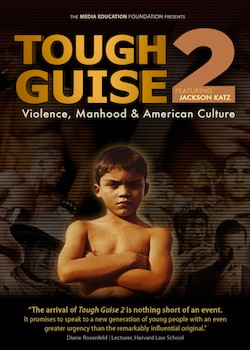
















Tough Guise

Written by  Jackson Katz and Jeremy Earp


About Jackson Katz and Jeremy Earp

Overview of the video

How to use this guide

Source List for Statistics in Tough Guise

Note to High School Teachers

Recent Articles about Masculinity by Jackson Katz and Sut Jhally


Video Sections:

Introduction

Hidden: A Gender

Upping the Ante

Backlash

The Tough Guise

The School Shootings

Constructing Violent Masculinity

Sexualized Violence

Invulnerability

Vulnerability

Better Men


Jackson Katz & Jeremy Earp


Jackson Katz has been one of America's leading anti-sexist male activists in the 1980's and 1990's. He is widely recognized for his groundbreaking work in the field of gender violence prevention education with men and boys, particularly in the sports culture and the military. He has lectured on hundreds of college and high school campuses and has conducted hundreds of professional trainings, seminars, and workshops in the U.S., Canada, and Japan.


Katz is the founder and director of MVP Strategies, an organization that provides gender violence prevention training and materials to U.S. colleges, high schools, law enforcement and military services, agencies, community organizations, and small and large corporations.


Katz is a former all-star football player who became the first man at the University of Massachusetts Amherst to earn a minor in women's studies. He holds a Master's degree from the Harvard Graduate School of Education, where his research concentration was the social construction of violent masculinities through sports and media.


In 1993 he co-created the Mentors in Violence Prevention (MVP) Program at Northeastern University's Center for the Study of Sport in Society. The multi-racial, mixed gender MVP Program is the first large-scale attempt to enlist high school, collegiate, and professional athletes in the fight against all forms of men's violence against women. MVP has worked with more than 20,000 high school students, as well as 2500 student-athletes at 35 colleges nationally. Katz and other MVP staff  have trained coaches, players, and front office personnel of the New England Patriots Football Club. Katz is the primary author of the program's innovative teaching materials.


Since 1996 he has been directing the first worldwide gender violence prevention program in the history of the United States Marine Corps.


Since 1990, Katz has lectured at more than 450 colleges, prep schools, high schools, middle schools, professional conferences and military installations in 41 states. He has spoken and done trainings at numerous public schools and community organizations across the country.


From 1988 to 1998, Katz was the chief organizer for Real Men, the Boston-based anti-sexist men's organization. Real Men leafleted at Fenway Park and Andrew Dice Clay concerts, provided speakers, sponsored debates and conferences, held fundraisers for battered women's shelters, and produced and distributed literature.


Katz has served on the boards of Boston-area battered women's shelters and is currently a member of the American Bar Association Commission on Domestic Violence.


He has published several academic articles on topics including educating college student-athletes in gender violence prevention, violent white masculinity in advertising, men's leadership in gender violence prevention education K-12, juvenile detention, masculinities in media and the male sports culture.


Jackson Katz is widely quoted in the national print media. He has appeared on numerous national and local radio programs in the U.S. and Canada, as well as television programs such as Good Morning America, Phil Donahue, Montel Williams, ABC News, 20/20, and the CBS Evening News.


Jeremy Earp teaches English at Parsons School of Design at New School University in New York City. He previously taught English at Northeastern University, and literature and intellectual history at the Art Institute of Boston. He also taught and served as coordinator of Adult Basic Education for the Adult Learning Program in Jamaica Plain, Mass. In addition to teaching, he has helped develop writing, critical thinking and media literacy curricula for universities and urban adult literacy programs. Prior to teaching, he worked for a number of years as a reporter for a daily newspaper outside of Boston.


Teachers Guide: Overview

Copyright  Jackson Katz and Jeremy Earp


The central premise of Tough Guise is that violence in America is overwhelmingly a gendered phenomenon, and that any attempt to understand violence therefore requires that we understand its relationship to masculinity and manhood. Playing off the image of Toto pulling back the curtain, the film announces its most basic assumptions:


*          that masculinity is made, not given (as opposed to maleness, which is biological);

*          that media is the primary narrative, pedagogical force of our time;

*          that media images of manhood Š across distinctions of race, ethnicity, and socioeconomic class -- therefore play a pivotal role in making, shaping and recycling specific attitudes about manhood;

*          that a sustained look at media images of manhood and violence reveals a widespread and disturbing equation of masculinity with pathological control and violence;

*          and, finally, that looking critically at constructed ideals of manhood by definition diminishes the otherwise silent power these very images might wield in shaping our perceptions of ourselves, our institutions and each other.


The last point is crucial, in that it underscores what we see as the ultimately hopeful message of this film: that change is possible, and violence can be prevented. In keeping with critical media studies, the film takes media images not simply as reflections of who we are, but as in some sense actively involved in telling us who we are. Reading media imagery and discourse critically can therefore change the way we perceive the world, ourselves and each otherŃwhile offering insight into how we might change the way media and other cultural/political institutions do business.


A key point is that the persistent media fantasy of the "real man" is often just thatŃmore fantasy than real. And as such, it needs maintaining. The "real man" caricature so often associated in media imagery and discourse with control, self-destruction and violence is of course neither fixed nor natural, and therefore can only maintain the illusion that it is so by remaining invisible and silencing alternatives.


The personal consequences of this silencingŃof ourselves and of othersŃare demonstrated in the film by the Oakland MenÕs ProjectÕs "box exercise." The filmÕs later examination of such persistent phenomena as menÕs violence against women, gay-bashing, and reckless, self-destructive behavior extends the argument by suggesting that we are in the midst of a crisis in masculinity, a crisis that has produced devastating consequences. Just as, institutionally, media and other cultural systems often play up violent masculine ideals at the expense of other, healthier possibilities, on an individual level we see all around us the boy who swallows his emotions for fear of ridicule, for fear of being labeled "feminine" or weakŃin essence, not a normal, natural male.


Violent masculinity is no more "natural" than media imagery. Both rely on controlled performances. The conclusion of this film amounts to this: By recognizing, and naming, masculine identity as a process, an uneasy performance built on exclusion and policing, the box can be broken openŃalong with the traditional assumption that masculinity must be connected with violence. Similarly, by looking critically at how institutionsŃfrom the media to political institutions to our schoolsŃoften play a role in shaping regressive and violent notions of manhood that maintain an unacceptably violent status quo, we stand to clear the way for individuals, male and female, to live freer lives.


How To Use This Guide


This guide is divided into eleven sections which correspond to the full length version of Tough Guise. The guide was written to aid educators in screening the video in classrooms, community groups, workshops, etc. Please feel free to print out, copy and distribute this guide as long as the authors, Jackson Katz and Jeremy Earp, are acknowledged.


In the future, MEF plans to offer this guide and other classroom materials in printer-friendly, PDF form. Please revisit this web site for updates or call MEF at 800-897-0089.  Thank you.


Source List


*Please note, this source list is in progress. Updated web addresses for missing data will be included soon.


Males are most often both the victims and the perpetrators in 90% of homicides.

U.S. Department of Justice, Bureau of Justice Statistics, Homicide Trends in the U.S.: Gender. http://www.ojp.usdoj.gov/bjs/homicide/gender.htm


Over 85% of the people who commit murder are men and the majority of the women who commit murder usually do so as a defense against men who have been battering them for years. 90% of the women in jail for murder are there for killing male batterers.

Bass, A. (1992, February 24). "Women far less likely to kill than men; no one sure why." The Boston Globe,  pp. 27.


Women commit about 15% of all homicides.

Stark, E. (1990). Rethinking homicide: Violence, race, and the politics of gender. International Journal of Health and Services, 20(1): 18.


More than 90 women were murdered every week in 1991; 9 out of 10 were murdered by men.

Violence Against Women, A Majority Staff Report, Committee on the Judiciary, United States Senate, 102nd Congress, October 1992, p. 2.


90% of people who commit violent physical assault are men. Males perpetrate 95% of all serious domestic violence.

U.S. Department of Justice, Bureau of Justic Statistics, Sourcebook of Criminal Justice Statistics Online. http://www.albany.edu/sourcebook/


The U.S. Department of Justice estimates that 95% of reported assaults on spouses or ex-spouses are committed by men against women.

Douglas, H. (1991). Assessing violent couples. Families in Society, 72 (9): 525-535.


It is estimated that 1 in 4 men will use violence against his partner in his lifetime.

Paymar, M. (2000). Violent no more: Helping men end domestic abuse. Alameda, CA: Hunter House Publications.


99.8% of the people in prison convicted of rape are men.

National Crime Statistics.


81% of men who beat their wives watched their fathers beat their mothers or were abused themselves.

U.S. Department of Justice, Bureau of Justice Statistics.


Studies have found that men are responsible for 80% to 95% of child sexual abuse cases whether the child is male or female.

Thoringer, D., Krivackska, J., Laye-McDonough, M., Jarrison, L., Vincent, O., & Hedlund, A. (1988). Prevention of child sexual abuse: An analysis of issues, educational programs and research findings. School Psychology Review, 17(4): 614-636.


The majority of  victims of menÕs violence are other men (76% M, 24% F).

U.S. Department of Justice, Bureau of Justic Statistics.


Out of 10,000 cases of road rage over 95% of them were committed by men.

AAA Foundation for Traffic Safety, "Aggressive Driving." http://www.aaafts.org/Text/agdr3study.pdf


76% of binge drinkers are young males.

1997 National Household Survey on Drug Abuse.

http://www.samhsa.gov/oas/NHSDA/1997Main/Table of Contents.htm


Males cause 86% of all drinking and driving incidents.

The National Highway Traffic Safety Administration.

http://www.nhtsa.dot.gov/people/injury/alcohol/alcupdate/alcprobupd.html


One in 12, or 8.2 million women, will be stalked at some point in their lifetime. 80% of the women stalked by intimates had also been physically assaulted by them.

Justice Department, November 1997


Every day, 15 children are killed by guns.

National Center for Health Statistics, Centers for Disease Control and Prevention, 1993.


The ratio of drug abuse of males to females is 2 to 1.

http://www.health.org/dawn


Note To High School Teachers


This teacher's guide was designed for the full-length (college) version of Tough Guise. The abridged version differs from the college version in two key respects. The abridged version is substantially shorter (57 minutes as compared to the 82 minutes college version), and spoken obscenities and visible nudity have been removed.


You will notice that one entire section, "Backlash," is present in the college version and teacher's guide, but not in the abridged version.


If you feel that any section of the film - in either the longer or the abridged format - is inappropriate for your students, you can simply choose not to screen that section.


Recent Articles by Katz and Jhally


The National Conversation in the Wake of Littleton is Missing the Mark

By Jackson Katz and Sut Jhally


First published in The Boston Globe; May 2, 1999, Sunday; City Edition; Focus Section; Pg. E1.


The events at Columbine High School 12 days ago have plunged us into a national conversation about "youth violence" and how to stop it. Proposals came last week from all corners - the Oval Office, Congress, living rooms across America. That we are talking about the problem is good; but the way we are talking about it is misdirected. Read the entire article.


Manhood on the Mat

By Jackson Katz and Sut Jhally


First published in The Boston Globe; February 13, 2000, Sunday; Third Edition; Focus Section; Pg. E1.


As professional wrestling explodes in popularity, cultural analysts are struggling to catch up to its significance for society. The traditional ways of seeing it - for example, as a morality play of good vs. evil - have been transcended, as wrestling has morphed into perhaps the ultimate expression of the entertainment industry's new, multiplexed model for success. Read the entire article.


Put the Blame Where It Belongs: On Men

By Jackson Katz and Sut Jhally


First published in The Los Angeles Times; June 25, 2000, Sunday, Commentary; Pg. M5.


The outrage in Central Park on Puerto Rican Day shocked and horrified not just New Yorkers but people everywhere. In its wake, the media have rushed to find an explanation, focusing on the "crowd" or "mob" psychology and the lack of a timely police response. These are important, but there is a far more central aspect that has remained largely unexamined: that men attacked and abused women. Seemingly "normal" men, perhaps fueled by alcohol, acted out publicly against women in an incredibly hostile and aggressive fashion. Read the entire article.


Video Sections:


Introduction


Summary


Masculinity - traditional masculinity in particular - needs to be looked at critically and in new ways. The idea that manhood or masculinity represents a fixed, inevitable, natural state of being is a myth. What a culture embraces as "masculine" can be better understood as an ideal or a standard - a projection, a pose, or a guise that boys and men often adopt to shield their vulnerability and adapt to the local values and expectations of their immediate and more abstract social environments. This projection or pose can take myriad forms, but one thatÕs crucial to understand in American culture at the millennium is the "tough guise": the front that so many boys and men put up based on an extreme notion of masculinity that emphasizes toughness and physical strength, and gaining the respect and admiration of others through violence or the implicit threat of it.


One of the most important places where boys learn to make sense of their world is the powerful and pervasive media system - which is arguably the great pedagogical force of our time. And one of the dominant features of the great media curriculum is a steady stream of images that define manhood as connected with dominance, violence and control. Boys and men have a huge stake in looking critically at media representations of masculinity and in confronting these problems - even if it means that they have to allow themselves, and others, to pull back the curtain to reveal whatÕs really going on in their lives.

------------------------------------------------------------------------


Key Points


*          The myth of the "real man" is linked intimately with the phenomenon of the "tough guise," wherein boys and men learn to show the world only those parts of themselves that the dominant culture has defined as manly. You can find out what those qualities are by simply listening to young men themselves.


*          Even at a remarkably young age, boys are likely to be well-versed in the rules of the macho game. Males absorb early on and from everywhere that not only is there such a thing as a "real" man, but also that there is a high price to pay for not qualifying as one.


*          For boys, across racial, ethnic and socioeconomic lines, being a real man often means being tough and strong, and fitting into the narrow box that defines ideal manhood.


*          It is vital that we understand that the real lives and identities of boys and men often - if not always, in some ways - conflict with the dominant "real man" ideal. Behind the bravado and the tough guy posturing, there is human complexity: for some men and boys, the abuse they suffered as children; others their problems in relationships; still others their fears and vulnerabilities. In other words, behind the guise is the real boy and man, the results of a sensitive, nuanced experience of the world that rarely airs in public.


*          Boys pick up on this act, learn whatÕs inside the box and whatÕs outside, from a culture that feeds - and feeds off of - masculine stereotypes. Beyond individual boys and their unique struggles, there are larger social and historical forces at work that affect the way individuals live their lives.


*          The media help construct violent masculinity as a cultural norm. Even a cursory survey of media imagery and discourse reveals quite strikingly the repeated and unquestioned assumption that violence is not so much a deviation as it is an accepted part of masculinity.


*          If we want to understand violence in America, we need to understand the growing connection made in our society - on both an individual and a systemic level - between being a man and being violent. And we need to understand how this has produced disastrous results for American society as a whole.


*          The fact is that some of the most serious problems in contemporary American society, especially those connected with violence, can be looked at as essentially problems within contemporary American masculinity. If we look at almost any category of violence we see that the perpetrators are overwhelmingly male. (For more information, see Scientific American's June 1999 Special Issue on Men, www.sciam.com/1999/0699mens/0699quicksummary.html).


*          Boys and men are inflicting an incredible level of pain and suffering, both on themselves and on others. And much of the violence is cyclical: many boys who are abused as children grow up and become perpetrators. But if we want to intervene in this deadly cycle we have to examine how our society encourages male violence in the first place.


*          Trying to improve the lives of boys and men is anything but a case of "male-bashing." Looking critically at what boys and men are doing - including harming themselves and others - is not in any way "anti-male." In fact, itÕs the opposite. ItÕs simply being honest about whatÕs going on in boysÕ and menÕs lives. Women have been at the forefront of trying to get men to start talking about these subjects, but itÕs not only girls and women who stand to benefit if menÕs lives are transformed; statistically speaking, the major victims of male violence are other males.


------------------------------------------------------------------------


Questions for Discussion & Further Study


1.  What are some benefits to boys and men of putting on the tough guise? When is it an effective and adaptive response, and when is it self-destructive and dangerous to others?


2.  Why do some people consider it "male-bashing" to point out that males commit the vast majority of violence? Discuss the term "male-bashing." It is a violent term that is, nonetheless, often used to describe women and men who are speaking out against violence. Why? What effect does some men's defensiveness have on our willingness to be honest about the disproportionate amount of violence perpetrated by males?


3.  Are there biological reasons why males commit the vast majority of violence? If so, why do rates of violence vary widely between different countries? Why is the U.S. by far the most violent society in the industrialized world? And how do we explain, if the primary cause of violence is biological or genetic, why the vast majority of males do not perpetrate violence?


4.  Many cultural commentators have noted that media representations of men of color (e.g. news accounts, roles in film, pornography, sports) have disproportionately shown them to be aggressive and violent. What effect do these portrayals have on the gender identity formation of boys and men of color? How do these portrayals influence the way the white majority sees men of color?

------------------------------------------------------------------------


Exercises


Classroom:


The box exercise: Draw a box on a chalkboard. Ask students to name characteristics of a real man. Write them inside the box. When the box is full, ask for themes (e.g. strength, toughness are equated with masculinity). Then ask them to name characteristics of men who don't measure up, and write these outside the box.. When you've gotten a sufficient number of words (e.g. wimp, wuss, fag), ask for themes. Then talk about how boys/men are boxed in by these definitions, and punished if they don't fit in.


For an explanation of the box exercise see page 87 of Helping Teens Stop Violence: A Practical Guide for Counselors, Educators, and Parents, by Allen Creighton with Paul Kivel, Oakland Men's Project. Alameda, CA: Hunter House Publishers, 1992. For more information about the  Oakland Men's Project write or call 1203 Preservation Way, Ste. 200, Oakland, CA 94612, tel: 510-835-2433.


Writing:


1.  Ask students to find another example, like the Wizard of Oz, that features a man creating an image that is not the actual man underneath (e.g. a character in a film or a piece of literature; movie stars themselves; sports personas, young men in school, college, etc.). Have them write about whether they feel it is obvious that the persona is just an act. As they explore and defend their point of view, ask them to consider how the persona differs from what they see as the more authentic person performing it. And ask them to explain what they see as the significance of this difference - between persona or performance and reality.


2.  Another option here is to show a film whose theme involves a male character whose masculine posturing creates conflict - both within himself and with others. Ask students to write about these internal and external conflicts. Have students pay specific attention as they write to the nature of the "masculine performance" involved. Some more specific writing topics might be: a) Analyze how this character-driven theme reinforces the overall meaning or theme of the film; b) Decide whether or not the film resolves this tension by reinforcing traditional, or hyper-masculine identity, or by subverting it and opening up new possibilities for male identity; or c) Write about the consequences of this conflict - for the life of the male character himself, and for others around him - and discuss how this relates to the overall theme or meaning of the film. (Possible films: Once Were Warriors; Born on the Fourth of July; Full Metal Jacket; In and Out.)


3.  As a class, view the film The Celluloid Closet, a documentary that specifically surveys masculine performance throughout the history of Hollywood film, and uncovers a striking homophobic subtext beneath masculine posturing. Ask students to write about this connection between traditional styles of masculinity and homophobia, and to find other examples in contemporary films or television shows.


4.  Ask students to write about a personal experience - involving themselves or someone theyÕve known - in which there was pressure to conform to a rigid gender stereotype. Key here is to encourage them to look critically at this experience, and to widen their discussion by connecting this personal experience to some of the larger issues presented in the film.


For a list of the statistics cited in Tough Guise, please see Sources.

------------------------------------------------------------------------

Suggested Reading


Archer, J. (Ed.). (1994). Male violence. London: Routledge.


Butterfield. F. (1995). All God's children: The Bosket family and the American tradition of violence. New York: Knopf.


Canada, G. (1998). Reaching up for manhood: Transforming the lives of boys in  America. Boston: Beacon Press.


Garbarino, J. (1999).  Lost boys: Why our sons turn violent and how we can save them. New York: Free Press.


Kivel, P. (1992). Men's work: How to stop the violence that tears our lives apart. Center City, MN: Hazelden.


Messerschmidt, J. (1993). Masculinities and crime: Critique and reconceptualization of  theory. Lanham, MD: Rowman & Littlefield.


Miedzian, M. (1991). Boys Will Be Boys: Breaking the link between masculinity and violence. New York: Doubleday.


Schiffman, J. R. & O'Toole, L. L. (Eds.). (1997). Gender violence: Interdisciplinary perspectives. New York: New York University Press


Hidden: A Gender


Summary


The way we talk about violence shapes the way we understand it. Assuming, rather than naming explicitly, the fact that violence is primarily in the domain of boys and men both hides this basic fact and perpetuates the myth that all men and boys are inherently violent. They are not. Yet the fact is that boys and men are responsible for a disproportionate amount of violence. Calling attention to this fact, as a fact, forces us to look not at the violent nature of boys and men, not at biological determinants, but at the violent "nature" of the ideas, images and values some boys and men associate with being a man. Simply put, it forces us to look at masculinity. So that when we hear discussions of how media is making "kids" violent, we need to pause. Girls absorb media ÉWhy then so much more violence from boys?


Similarly, we need to look at how media frame the issue of male violence generally - how media tend to use language that deflects attention from the glaring fact that males are responsible for the vast majority of violence. Again and again we find examples in media of language that de-genders violence - be it passive voice constructions that hide the recurring gender patterns that characterize violence, or the persistent use of androgynous phrases such as "youth violence" and "kids killing kids," phrases that not only eschew journalistic precision, but obscure the source of the problem we face by failing to name boys and men as the usual perpetrators. When we gender the way we talk about violence - whether violence on the street, in the movies, or within or resulting from our institutions - we are forced to examine masculinity as part of the problem, and when we do so, we move closer to doing something meaningful about it.


Key Points


*            Violence needs to be seen as a gender issue, especially as an issue caught up in how we as a society think about masculinity and manhood.


*          In the national conversation about violence, itÕs rarely referred to as a gender issue, although one gender, men, perpetrates approximately 90% of the violence.


*          One of the ways dominance functions is that the dominant group avoids being examined. We focus always on the subordinated group - blacks or Latinos when we talk about race; gays when we talk about sexual orientation; women when we talk about gender. Unconscious or not, this focus helps the dominant group remain invisible and protects the status quo.


*          This dynamic plays out in a number of ways when it comes to discussions of violence. One is the rampant use of the passive voice when we talk about crimes against women, which shifts our focus off of male perpetrators and onto female victims and survivors. (see Julia Penelope in "Suggested Reading.")


*            Another example, also embedded in language, can be seen in the sort of linguistic neutering of violence found in newspaper headlines and stories all around the country - which again and again speak of "youth violence," and of "kids killing kids," not boys killing boys and boys killing girls.


*          Few would argue with the common-sense idea that dealing with a problem requires, first of all, that you name it. If we donÕt frame violence as the overwhelmingly male, masculine phenomenon that it is, then subsequent discussions about the causes of violence are destined to ignore one of the key elements.


*          A key indication that de-gendered discussions of violence serve to universalize or naturalize violence as a male thing: when girls commit violence, that's always the subject. When girls turn violent, the gendered nature of the crime is always part of the discussion. The same needs to be true with male violence. The bottom line is that violence has been gendered masculine.


*          A key goal in violence prevention is to make masculinity visible. To make explicit the overwhelmingly masculine character of most violence. And to reject the idea that "it goes without saying" that males are more violent as anti-intellectual, biologically deterministic, and implicitly anti-male.


*          Making masculinity visible is the first step to understanding how it operates in the culture and how definitions of manhood have been linked, often unconsciously, to dominance and control. Making masculinity a key part of the equation is therefore step one in dealing effectively with the problem of violence in our society.


Questions for Discussion & Further Study


1.   Many people think the very concept of "gender issues" is synonymous with "women's issues." Talk about why this is so. And discuss how this misconception makes it difficult for many men, and women, to understand the gendered nature of men's lives.


2.  Why is it important to identify the gender of the perpetrators of violence? How would gendering the discussion help contribute to reducing violence?


3.  What is the difference between saying "male violence" and "men's violence?"


4.  What is the difference between using the common term "violence against women" rather than the less commonly used "menÕs violence against women"? And why is this difference significant?


5.  Why did "Thelma and Louise" become so controversial, when movies featuring men's violence against women are released regularly with little protest?


6.  Is it "nit-picking" or needlessly "politically correct" to suggest that we should not use male-inflected language to suggest universal ideas and experiences? Are we overreacting or reading into things too much, for example, when we question descriptions such as "man has always searched for answers," or "manÕs religions have unifying themes" as inherently exclusionary and sexist? How might the way we approach and think about such formulations be different if we said "men and women" instead?


7.  What is meant by the term "politically correct"?


8.  When is it time to stop questioning something? To stop thinking critically about an issue or an idea (such as the importance of how language is used)? And who decides?

------------------------------------------------------------------------

Exercises


Classroom:


1.  Language exercise # 1: Youth Violence


2.  Language exercise # 2 : Violence Against Women


Writing:


1.  Ask students to find and cut out a newspaper or magazine op/ed column or article about violence. Have them bold the words used to describe perpetrators. Rewrite the piece using gendered language. (i.e. "A 15-year-old boy killedÉ" rather than "A 15-year-old youth killedÉ")


2.  Ask students to write about an experience theyÕve had in which language influenced what happened. Ask them to think about how the experience might have been different if the language involved was different.


3.  Ask students to write in response to the following: Do words have power? How much? How? Why or why not? Give examples.

------------------------------------------------------------------------

Suggested Reading


Katz, J. & Jhally, S. (1999, May 2). "Missing the mark". The Boston Globe, pp. E1.


Penelope, J. (1990). Speaking freely: Unlearning the lies of the fathers' tongues. New York: Pergamon Press.


Spender, D. (1985). Man made language. London: Routledge & Kegan Paul.


Uping The Anti


Summary


What comes to be accepted as "masculine" in a society is largely a cultural construction, not simply an expression of a shared male nature. Key here is distinguishing biology from learning, seeing masculinity - or, more accurately "masculinities" - not in biological terms, but as a learned set of standards or styles embedded deeply in the values and ideology of culture. As culture evolves, so does our notion of what constitutes "manliness." What is considered supremely "masculine" in one context - say, George Washington in a wig and knee breeches or Mel Gibson in a kilt - might be the very definition of "unmanly" in another.


The fact that masculinity is not fixed, that male identity is fluid and subject to change, is of course cause for hope that violent ideals of masculinity are not inevitable; if "masculinity" by nature is forever shifting, and if weÕre plagued in our own cultural moment with media images that continually connect masculinity with control and violence, then the possibility exists for better images and healthier visions of what it means to be a man. But even a cursory look at some of the more dominant images consumed by young men in particular suggests that the way media have portrayed manliness seems to have devolved as much as it has evolved.


The marked increase over time in the size of representations of men's bodies, and the concomitant increase in gun size and killing power, provides a kind of cultural rorschak test. They are indications of how the stakes have been raised, how the real man fantasy peddled to and consumed by so many boys has grown increasingly physical, violent and mean. Significantly, even as we observe this phenomenon of increased male body size, particularly in the kinds of representations that predominate in action films, professional wrestling and video games, we can trace simultaneously the shrinking of the ideal body size of women. Such increasingly impossible and potentially destructive images need to be taken seriously, especially in the context of heightening concerns not only about male violence - but about steroid abuse by boys and men, and anorexia among girls and women.

------------------------------------------------------------------------


Key Points


*          One way to understand the meaning and value of something in American society is to look at how it is represented in the media - and to understand that the media both reflect and produce these meanings and values.


*          Images of men and masculinity have changed dramatically and in revealing ways over the past 50 years, particularly in terms of the size of menÕs bodies. And these changes tell us a story about whatÕs going on in the culture.


*          The representation of the ideal masculine body has grown considerably over time. The ideal has always been a fantasy, but now the fantasy is bigger. The increasing size of Superman, Batman, pro wrestlers, GI Joe and the characters of Star Wars is especially interesting and revealing given that representations of the ideal, fantasy female body have been shrinking in inverse proportion. (For more discussion of how women's bodies are represented in media, see Jean Kilbourne's films Slim Hopes & Killing Us Softly III.)


*          It is telling that in an era when women have been challenging male power in business, the professions, education, and other areas of economic and social life, the images of womenÕs bodies that have flooded the culture depict women as less threatening. TheyÕre literally taking up less symbolic space. At the same time, images of men have gotten bigger, stronger, more muscular and more violent. It stands to reason that one of the ways that men have responded to womenÕs challenges is by overcompensating and placing greater value on size, strength, and muscularity.


*          The same pattern can be seen in the way gun imagery has changed over the last 50 years; from Humphrey Bogart and Sean Connery, to Clint Eastwood, Sylvester Stallone and Arnold Schwarzeneggar, the guns - along with the masculine codes they represent - have become more and more imposing, violent and menacing.


*          Bottom line: There is nothing natural about images. TheyÕre made, and how theyÕre made says something about those in the culture that make them and consume them. And the fact is that in our culture men have been the primary authors of our popular culture. When we look at changes in pop-cultureÕs images, weÕre also looking at the changing psyches of their creators and consumers.


*          Still, the images of violent masculinity that pervade media represent more than the public screening of the private and pathological fantasies of the individual males who dream them up. They are also windows into massive historical, structural shifts.


------------------------------------------------------------------------


Questions for Discussion & Further Study


1.   What are some of the potential effects on boys and men of trying to live up to our culture's ideal of physical size and strength? Emotional effects? Health effects? What is the relationship between cultural ideals of male strength and steroid abuse?


2.  Why are guns sometimes referred to as "great equalizers?" How do individual and cultural notions of manhood contribute to boys' and men's gun ownership and usage?


3.  What are some areas of life (aside from muscles) where size matters? Why?


4.  What, or whose, interests are served - or have been served - by the increasing size and heightening violence associated with the male body? What, or whose, interests have not been served?


5.  Do you feel that the media simply reflect changes in society, or do they in some way inspire change? If the former, why was the stereotypical size of the "masculine" male so much smaller in the past? If the latter, explain how and why you feel individuals are susceptible to media influence?


6.  What do you make of the increasing presence of overtly sexualized male bodies in advertising, posed in provocative, at times submissive, ways? Could this increased visibility of the male body as sexualized object - rather than as a powerful agent - be a response to shifting attitudes in the culture about masculinity?

------------------------------------------------------------------------


Exercises


Classroom:


1.  Have students find and bring in (or use the images provided here) a full-bodied magazine picture (or video) of a male TV, movie, or sports star from the 1940s, 50s or 60s. At the same time - or for a later class - have them find and bring in an analogous star from the 1980's or 90's. (For example, you might pick a football star from the early 1960's, as well as a current NFL star.) In class, have them discuss the differences and similarities of their bodies, and offer some reasons for the difference: Better nutrition? Better weight training equipment and techniques? Social changes? Be prepared to discuss the possibilities.


2.  Do the same as above with advertisements featuring females. Have students pay attention here, and above, not only to the size of the bodies featured, but to how they are posed.


3.  Have students bring in an example from advertising (a print ad, a synopsis of a TV commercial, etc.) in which masculinity, or manhood, is referred to explicitly - whether used literally or ironically. Have them explain what they feel the people who made the ad are trying to do; specifically, how are the advertisers attempting to use masculinity, and gender, to sell their product? What assumptions do the advertisers seem to be making about those who will be influenced by the ad?


Writing:


1.  After sharing ideas on one or two of the discussion topics above, ask students to write a paper analyzing masculinity in a TV or print ad, or other media image. Ask them to focus specifically on a) the way masculinity is portrayed, especially as related to the body; b) what that portrayal signals about what kind of man is pictured; and c) what effect(s) this is designed to have on those looking at the image.


2.  Have students write an essay about "strength." Ask them to look the word up in the dictionary, and to come up with as many takes on the word as possible. The key to the assignment is to have them offer as complete a definition of "strength" as possible, using examples from the dictionary, their own experience, literature, films theyÕve seen, etc. To provide more specific focus, you might ask them to consider and examine the breadth and nuance of their definition against the common association of strength with physical size and ability.

------------------------------------------------------------------------


Suggested Reading


"As GI Joe bulks up, concern for the 98-pound weakling." (1999, May 30). New York Times, section 4, page 2.


Bordo, S. (1999). The male body: A new look at men in public and in private. New York: Farrar, Straus and Giroux.


Hall, S. (1999, August 22). "The troubled life of boys: The bully in the mirror." New York Times, section 6, page 31.


Kilbourne, J. (1999). Deadly persuasion: Why women and girls must fight the addictive power of advertising. New York: Free Press.


Klein, A. (1993). Little big men: Bodybuilding subculture and gender

construction.  Albany, NY: SUNYPress.


Lehman, P. (1993). Running scared: Masculinity and the representation of the male body. Philadelphia: Temple University Press.


Nelson, M. B. (1994). The stronger women get, the more men love football: Sexism and the American culture of sports. New York: Harcourt Brace.


Pope, H.G., Gruber, A.J., Choi, P., Olivardia, R. & Phillips, K.A. (1997, December). "Muscle dysmorphia: An underrecognized form of body dysmorphic disorder." Psychosomatics, 38:548Š557.


Backlash


Summary


We gain insight into masculinity and its contemporary relationship to violence when we consider history. What comes to be considered "masculine" is always in process, always to some extent connected to time, place and history - individual and local as much as institutional. The current crisis in masculinity might therefore be constructively understood as a response, at least in part, to massive cultural changes.


The womenÕs movement, the civil rights movement, and gay and lesbian rights movements presented a direct threat to traditional notions of manhood, rendering dominant straight, white masculinity visible and therefore vulnerable. The immense popularity of masculine icons such as John Wayne, Ronald Reagan and Sylvester Stallone might be seen, then, as an expression of longing for backlash versions of violent, traditional, dominant versions of masculinity that could, in fantasy at least, return America - especially dislocated American males - to less confusing, less threatening times, times untouched by the progressive political and social gains of the 60s and 70s.

------------------------------------------------------------------------

Key Points


*          The changes weÕve seen in images of masculinity are in part a response to a perceived threat to traditional conceptions of the dominant idea of masculinity - that is of white, middle-class heterosexual masculinity.


*          The social movements that arose in the 1960s presented a threat to established power that still reverberates. The Civil Rights Movement, the Women's Liberation Movement, the gay and lesbian movements, and the anti-war and student movement that opposed U.S. intervention in Vietnam disrupted entrenched power interests and the traditions on which they were based. In particular, these movements threatened the dominant white heterosexual masculinity that had held largely unquestioned social, political, economic and cultural power in the United States.


*          Some men have not reacted well to these changes and there has been a backlash. Again, our media heroes tell a story. Sam Kinison, Andrew Dice Clay, Howard Stern, Rush Limbaugh and the current crop of so-called menÕs television shows all rose to prominence and widespread popularity by tapping into and trading in anger towards strong, independent women. All of these acts found an audience by explicitly trashing either feminism, or any notion of a woman as something more than a tool for menÕs pleasure.


*            Similarly, we can see examples all around us of a backlash against the hard-fought gains of gays and lesbians. As with the womenÕs movement, while many heterosexual people, men and women, have responded very positively to these changes, many have not. The rise in anti-gay violence is one of the clearest indications that a lot of young men are very insecure and anxious about their sexual and gender identities as the culture increasingly opens up.


*          A number of scholars have argued that on top of all the internal social movements that were transforming American life in the 1960s, there was also an external aspect represented by the loss of the Vietnam War. And one way that some people responded to that was to say that we lost in Vietnam because we had lost our masculine pride - had Sly Stallone held sway in the 60s and 70s, and with him all the old-school masculinity he embodied in Rambo and Rocky, then maybe weÕd still be the great (read: macho) country we were before Vietnam and the Civil Rights movement came along and emasculated America.


*          The ultimate political manifestation of this backlash against the social movements of the 1960s and 1970s came in the election to the presidency in 1980 of the arch conservative Ronald Reagan. After a campaign in which Reagan and his handlers expertly employed masculine iconography against every progressive gain of the 60s and 70s, his election marked the culmination of the belief that the reason America had lost its way was that it had become too weak, too soft. His cowboy image and his right-wing beliefs represented a vision of America rooted deep in the past, when blacks were not demanding equality, when women accepted their second-class status, when gays were still in the closet. Basically, a past when men were still men and knew what that meant.


*          To really understand what Ronald Reagan represented culturally and politically, we have to understand the career of another very prominent and powerful movie actor, John Wayne, an incredibly important force in the shaping of post-war American masculinity. After the emasculating performance of Jimmy Carter, Reagan - reverberating in the wake of Wayne - was the man for the job.


*          ItÕs key to remember, of course, that when we talk about "John Wayne," we're talking about an actor playing the role of John Wayne. WeÕre talking about a performance, one that is linked to the sort of fa¨ade-keeping and simulation at the heart of every "real man" performance.


*          The relationship between John Wayne and Ronald Reagan shows us two important things. First, that the ideal of manhood that was being offered as an alternative to the changes of the 1960s and 70s came from the past, when racism, sexism and homophobia were the norm. Second, that the image that people like Ronald Reagan were trying to reproduce was already an act that attempted to repress a more real, complex masculinity.


------------------------------------------------------------------------


Questions for Discussion & Further Study


1.   Numerous writers and theorists have argued that cultural changes catalyzed by the various multicultural women's movements over the past generation have created historically unprecedented opportunities for women. How have some of these changes affected men's lives, both positively and negatively? Is sexual equality a zero sum game, where one sex can gain only at the expense of the other?


2.   Seventy-five percent of women who are murdered by their husbands, boyfriends, or exes are killed after they leave or seek to leave the relationship. What is the connection between this phenomenon on the individual level and the sociological insight that groups tend not to concede power without a struggle of some sort?


3.  The vast majority of gay-bashing incidents are perpetrated by young men. Discuss the reasons for gay-bashing, focusing on the gender and sexual identities of the perpetrators.


4.  Much of the contemporary discussion about gender and politics focuses on women. But men, too, are influenced dramatically by gender ideology. Discuss some of the ways that men's sense of themselves as men affects the way they vote, align themselves politically, or think about social and political issues. How do differences of race and socioeconomic class complicate this?

------------------------------------------------------------------------


Exercises


Classroom:


1.  Have students find and bring in a newspaper article that they feel illustrates a case of backlash, an example of someone acting violently when presented with a perceived threat. Ask them to be prepared to discuss the article in relation to gender, based on the ideas about "backlash" discussed in the film.


2.  Have students bring in a newspaper article about politics which they feel in some way relates to masculinity - be it the masculinity of a candidate as he tries to project a certain image; the masculinity of a politician expressing views on a particular issue; or perhaps a political story written in a way that makes certain assumptions based on gender. Discuss the ways that the political realm - issues, politicians, candidates for office, etc. - often intersects with personal issues that regularly play out with regard to gender.


3.  In keeping with this attempt to draw connections between the public and private realms, particularly as these connections play out politically, ask students to name political issues that they feel are more "masculine" concerns; then do the same with issues they feel are more "feminine," stereotypically or not. Talk about what they come up with, making connections to the "gender gap" that is now so prominent a part of political discussions. Also, discuss the ways in which politicians might play to the fears and anxieties of men; what kinds of politicians are more likely to do this? Is one ideology, or party, more likely to do so? Is one more "masculine" than another?


Writing:


1.  Watch a film in class that deals prominently with a clear instance of personal backlash by a male trying to assert - or reassert - his authority and power, and ask students to write in response to it. Ask them specifically to examine the nature of the threat that provoked the violent response, paying close attention to how gender is presented. Was there a threat to the characterÕs masculinity? Did the fear of the feminine play a role? Was there any homophobia involved? And how did this incident relate to - or reinforce - the overall theme of the film?


2.  Do the same as above with a short story, with special attention to the last point about relating the specific incident, and issues of character, to more general themes in the work.


3.  Have students write in response to something going on in current events - something they might find in a newspaper or see on the news - which they feel represents a case of institutional, or cultural backlash. For example, a cultural movement involving students who want the biblical creation story taught in their science classes (which would be a response, of course, to fears that culture has become too secularized.) For this assignment, ask them to choose something, specifically, which they feel is significant in terms of gender, an issue or incident in which ideas about masculinity are involved.

------------------------------------------------------------------------


Suggested Reading


Blumenfeld, W. (Ed.). (1992). Homophobia: How we all pay the price.  Boston: Beacon Press.


Faludi, S. (1991). Backlash: The undeclared war against American women. New York: Crown.


Gibson, J. W. (1994). Warrior dreams: Paramilitary culture in post-Vietnam America. New York: Hill and Wang.


Jeffords, S. (1994). Hard bodies: Hollywood masculinity in the Reagan era. New Brunswick, NJ: Rutgers University Press.


Jeffords, S. (1989). The remasculinization of America: Gender and the Vietnam War. Bloomington, IN: Indiana University Press.


The Tough Guise


Summary